Tuesday, July 6, 2010

In Dakar


I am finally in Dakar but very busy. I only have time to post this photo.

Sunday, July 4, 2010

Almost There


I'm at the Logan International Airport waiting to board the plane. I should be in Dakar by tomorrow morning. In the meantime, I've posted this video of a Senegalese Drumming and Dance demonstration from our three days of Orientation.

http://www.youtube.com/watch?v=IYcjjHw3QJI

Friday, July 2, 2010

Day 1 in Boston


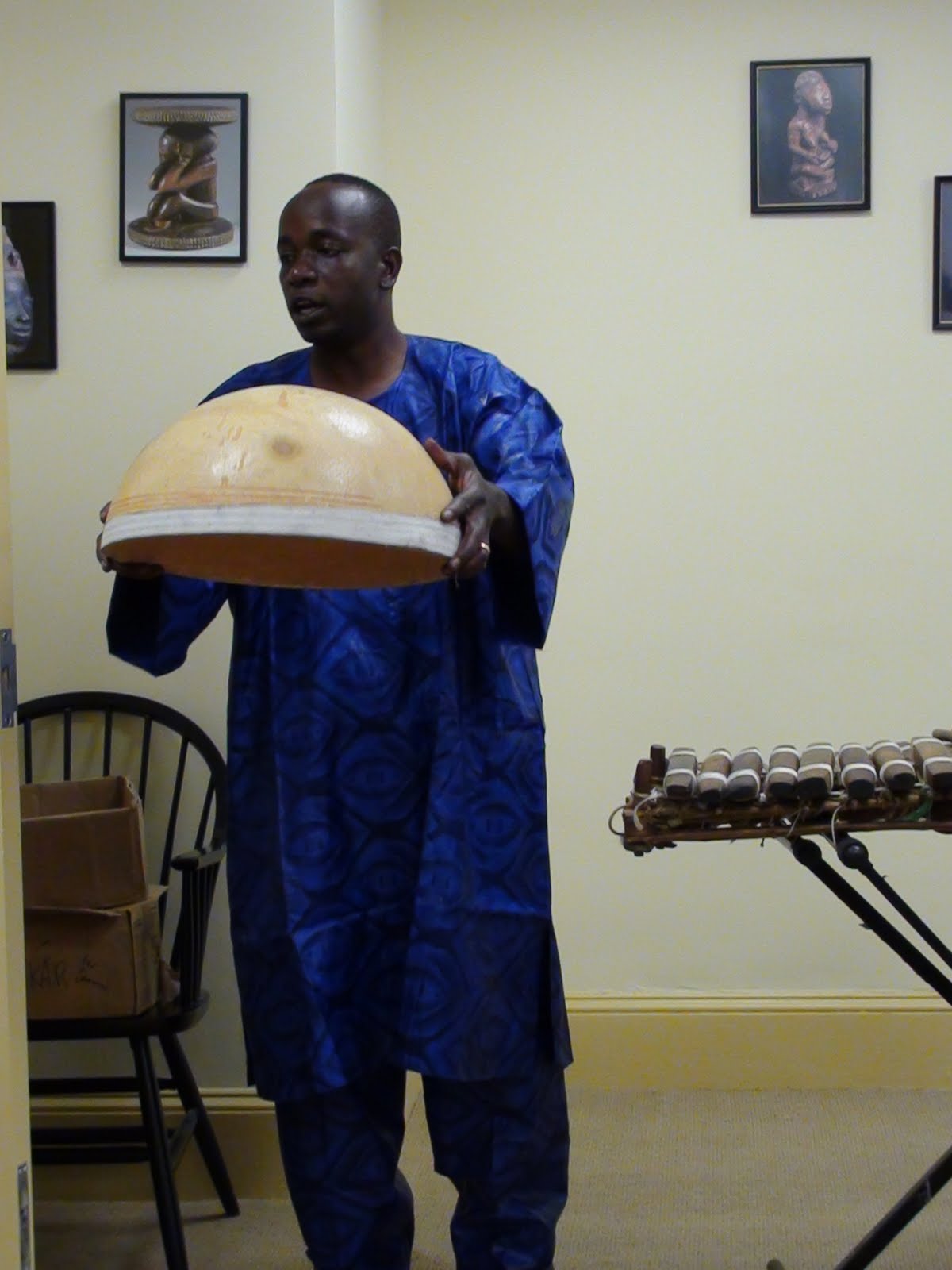
Well, I arrived in Boston at 1am Thursday; checked into the hotel; slept for a few hours then headed out to walk the Freedom Trail with three of the other Fulbright-Hays participants. Bunker Hill was at the end of the trail and we climbed the steps to the top and took this picture of Boston. We then rushed to the Center for African Studies at Boston University for our first day of orientation which included a Balafon performance by Balla Kouyate: http://www.youtube.com/watch?v=nTXSFYTf0ks

Wednesday, June 23, 2010

Readings


Well, school is out and I leave for Boston next week. I still have many things to do in preparation for the trip including a lot of reading.
Here's the list:
Mbye Cham, “Oral Traditions, Literature and Film in Africa: The Dynamics of Exchange.” In Robert Stam & Alessandra Raengo (Eds.), Literature and Film:
A Guide to the Theory and Practice of Film Adaptation. Malden, MA: Blackwell Publishing, 2005. Pp. 295-312.Mariama Ba,
So Long A Letter (novel).Curtis Keim,
"Mistaking Africa: Curiosities and Inventions of the American Mind" (2nd edition). Westview Press 2009. Fiona McLaughlin,
“On the Origins of Urban Wolof: Evidence from Louis Descemet’s 1864 Phrase Book,
” Language in Society, Vol. 37, (2008), 713–735.Fiona McLaughlin,
“The Governor and the Marabout: Contesting the Place Faidherbe in Saint-Louis du Sénégal.” Unpublished paper.Ivor Miller,
“Cuban Abakuá Chants: Examining New Linguistic and Historical Evidence for the African Diaspora,” African Studies Review, Vol. 48, No. 1 (Apr., 2005), pp. 23-58.John Parker & Richard Rathbone,
"African History: A Very Short Introduction." Oxford University Press. 2007.
Selection of poems by Leopold Sedar Senghor.AbdouMaliq Simone,
“On the Worlding of African Cities,” African Studies Review, Vol. 44, No. 2, (Issue on Ways of Seeing: Beyond the New Nativism), (Sep., 2001), pp. 15-41.Leonardo A. Villalón,
“Senegal,” African Studies Review, Vol. 47, No. 2 (Sep., 2004), pp. 61-71.Wilson Fall, W.,
“The Upward Mobility of Wives: Gender, Class and Ethnicity," The Journal of African Philosophy, Vol. 12. No. 2, 1999, 175 – 195. Wilson Fall, Wendy,
“The Family, Local Institutions and Education.” Drylands Research Institute. UK 2000. Series on Senegal. Drylands Research Working Paper 20.

Tuesday, May 4, 2010

Mistaking Africa


Indeed, there is more than one story of Africa. I have never been there but, when my sister learned of my coming seminar in Senegal, she laughed and said she knew it would just be a matter of time before I would find myself there. She said this trip would actually be a type of homecoming for me.

My story of Africa began when I was in third grade. Twenty-five cents would get me into the Saturday matinee where my favorite movies were about the adventures of Tarzan. I remember little about the actual plots. It was mostly the action scenes that captured my imagination. Whenever Tarzan would dive into the water, he was sure to have an encounter with a crocodile. After a few minute of underwater spins, Tarzan would pull out his knife and stab the crocodile and then move on to complete his adventure.

I remember even less of the white man’s encounters with the African people. My interests focused more on the elephants summoned by his distinctive call; and, of course, his primate sidekick, Cheetah. But, what I admired most was Tarzan’s ability to fly through the jungle swinging from vine to vine. Tarzan’s Africa was truly fantastic and I strove to recreate that world in whatever way I could.

I would tie ropes, sheets or whatever I could to whatever object I could to create my own jungle canopy from which I could swing into my own heroic adventures. What my sister remembers, however, is when I would take off my shirt and I wrapped her faux leopard skin coat around my waist then swing from branch to branch or sofa to chair.

Indeed, at age eight, I was an expert on Africa. These decades later, my French is weak and I know no Wolof but, should we go for a swim, I’m ready to take on the crocodiles.

For a bit of reality
You can also watch these interesting short videos
http://www.youtube.com/watch?v=D9Ihs241zeg (a TED lecture by Nigerian writer, Chimananda Ngozi Adichie, entitled “The Danger of the Single Story.”)

http://www.youtube.com/watch?v=c-jSQD5FVxE (a dramatic enactment of a piece by Kenyan writer, Binyavanga Wainaina, entitled “How Not To Write About Africa.”)

Co-Directors


Dr. Mbye Cham ane Dr. Samba Gadjigo will be co-dirctors of the Fulbright-Hays Seminar Abroad in Senegal.


Dr. Cham is chairman of the Department of African Studies at Howard University in Washington D. C.


Dr. Gadjigo is professor of French and African Studies at Mount Holyoke College in South Hadly, MA

Sunday, May 2, 2010

My fellow Fulbright-Hays travelers


I will be traveling with 15 other people from 11 other states. I am the only teacher from Texas.

Kristine Sieren from Dodge City, KS - Terese Heil from Frazer, MT - John DeLisa from Staten Island, NY - Chon Lee from Santa Monica, CA - Laureen Hurt from Pittsburgh, PA - Amy Flanders from Laconia, NH - Janice Yap from Honolulu, HI - Cathleen Carroll from Ocean Grove, NJ - Yumi Matsui from Oakland, CA - Richard Dubois from Raleigh, NC - Suzanne Paeglow from Santa Cruz, CA - Therese Laux from Omaha, NE - Arlis Groves from Elk Grove, CA - Steadman Rogers from Lawrence, KS - Suzanne Protheroe from Iowa City, IA and me.